Wealth management firms are operating in a very different environment than they were even a few years ago. Advisors are working across locations, core systems are cloud-based, and third-party platforms are deeply embedded in day-to-day operations. At Omega Systems, we see many firms still relying on security models that haven’t kept pace. That disconnect is where risk begins to surface – and why more firms are evaluating secure access service edge (SASE) as a more practical path forward.
The Gap Between How Firms Operate and How They’re Secured
In practice, we see this play out all the time – cybersecurity challenges don’t usually start with sophisticated attacks. They start with a more fundamental issue: the way the business operates has changed, but the way it’s protected often hasn’t.
Your advisors are working remotely – from home offices, client sites, and while traveling. At the same time, your core systems – from Microsoft 365 to portfolio management platforms and CRM tools – now live in the cloud or across third-party environments.
Yet security is still often designed around a central office model, where access is granted once a user connects to the network.
Why the Traditional Model Falls Short
This tends to create friction for users – and more exposure than most firms realize. VPN-based access can introduce inconsistent performance, but more importantly, it creates a broad level of trust once a connection is established. If credentials are compromised, that access can extend far beyond what that user actually needs – often without you realizing it right away.
That mismatch between how the firm operates and how it’s secured is where things start to break down.
Today’s Threat Landscape Is Identity-Driven
Most attacks affecting financial services firms today are not the result of attackers breaking through a firewall. Instead, they rely on valid credentials – obtained through phishing, device compromise, or other methods – to gain access as legitimate users.
Once inside, traditional network-based security has limited ability to restrict movement or detect misuse quickly.
For RIAs, family offices, and financial planning firms, this shows up in real, practical ways.
A single compromised account can expose your client data and internal systems faster than most teams expect. And because many firms still rely on fragmented tools and manual processes, detection and response timelines can lag behind what regulators and clients expect.
In this environment, security needs to be tied to identity and context – not just network location.
How SASE Aligns Security with the Way Firms Work
SASE shifts security away from the network and toward the user. At its core, this is an identity-based security model, often aligned with zero trust principles.
Instead of routing users through a VPN and granting broad access, it connects users directly to the applications they’re authorized to use, with identity and device context continuously verified.
From Network Access to Application Access
Traditional VPN Model |
Identity-First SASE Model |
| Users connect to the network | Users connect directly to applications |
| Network-level access | Application-level access |
| Trust established at login | Continuous identity verification |
| Broad access if credentials are compromised | Access limited to what’s explicitly authorized |
| Multiple tools and appliances | Unified, cloud-delivered platform |
This model limits lateral movement and reduces the impact of compromised credentials.
For wealth management firms, this aligns more closely with how teams operate today.
Security follows the user across remote locations and cloud platforms, allowing firms to apply consistent controls without relying on perimeter-based infrastructure or introducing unnecessary friction.
Conclusion: Closing the Gap
 The shift toward distributed work and cloud-based operations isn’t slowing down. For wealth management firms, the challenge is making sure security evolves alongside it.
SASE reflects a model that actually matches how firms operate today – prioritizing identity, limiting unnecessary access, and improving visibility.
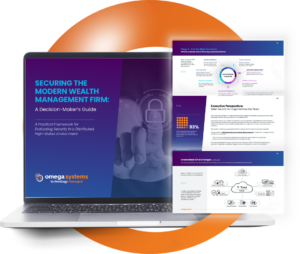
For a deeper look at how to evaluate SASE in your environment, download the full buyer’s guide.